

Defining Romance
With romcom author Ali Rosen.

Hello lovely readers! How are you today? If you’ve been reading my newsletter these last few months, you know that last November I experimented with incorporating interviews, including one with Lebanese cookbook author Maureen Abood about the word legacy and another with author Adam Roberts about being a food person. It is so fun talking to other writers, hearing about their process and being inspired by what they’re passionate about. I hope you enjoy today’s Q&A with romcom author Ali Rosen, who is also a James Beard Award-nominated cookbook writer and Emmy-nominated TV host of Potluck with Ali. As always, thank you for being here!
ROMANCE: a close relationship between two people who are in love with each other. The feeling of excitement or mystery that you have from a particular experience or event. A story about love. (Source: Cambridge Dictionary)
What I love about being a word nerd and researching definitions and etymology and then thinking about it within the scope of my own life, is that I’m often surprised. I previously had quite a narrow definition of romance, thinking of it as being a relationship between two people, or using the word romantic to describe something swoon-worthy or in a love sense. I love thinking about romance as the excitement or mystery you have from an experience or an event or even a place.
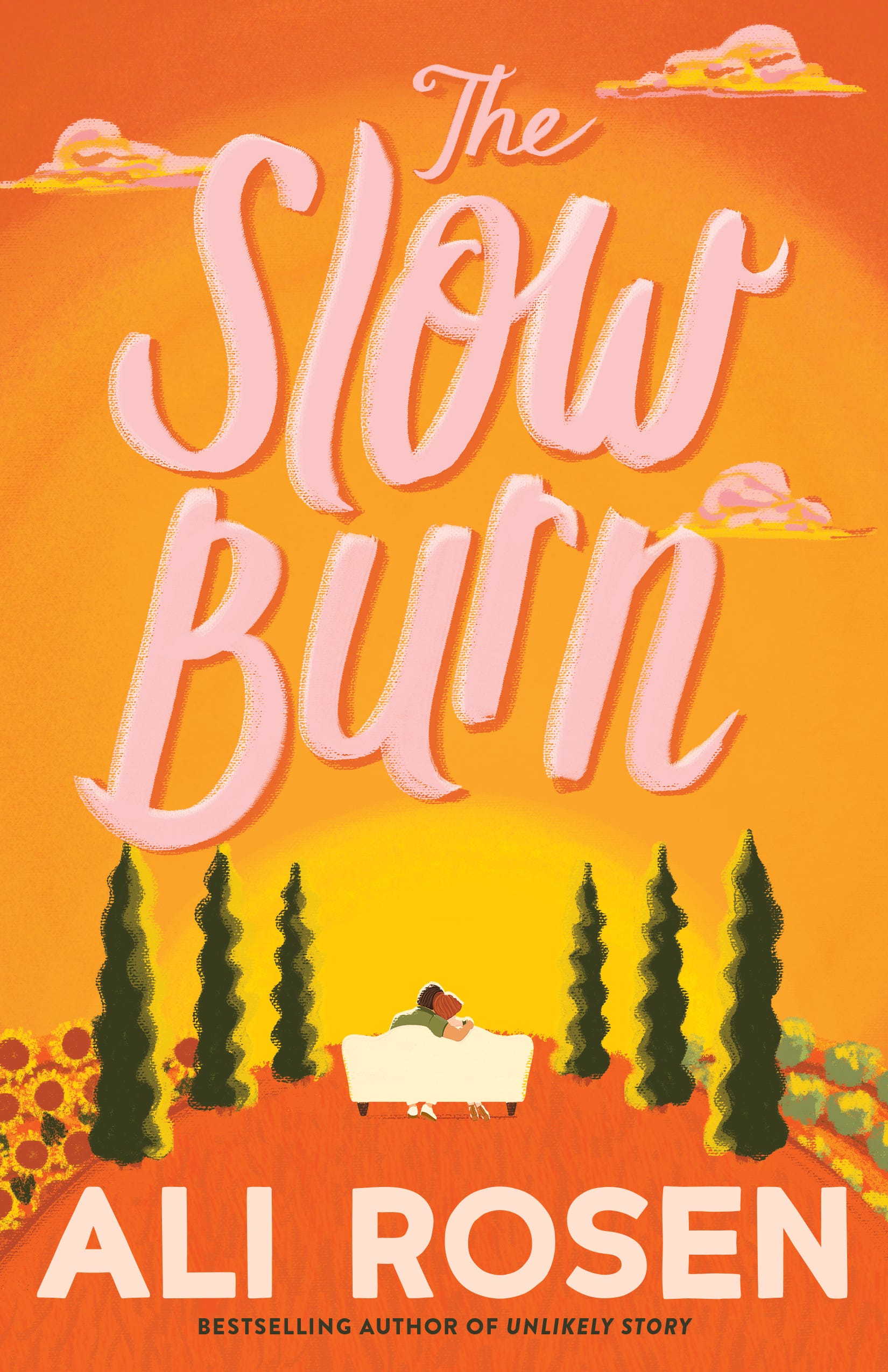
I used to think I didn’t like reading romance novels (or maybe it was because I was too busy reading memoir, both because I enjoy them and I’m trying to be well-versed in the genre I hope to publish in). These days, romance is one of the most popular and best-selling genres, and the category goes far beyond lusty trysts (though those are fun to read too!). One of the books that changed my mind about romance novels was New York City-based author Ali Rosen’s first novel, Recipe for Second Chances, and it was a thrill to read her second novel, Alternate Endings, and see how much more she had developed her craft and her voice. I still need to read her third book, Unlikely Story, but I’ve started her delicious fourth novel, Slow Burn. I am obsessed with the heroine, Kit, a Michelin-starred chef whose boyfriend breaks up with her on the night her New York City restaurant burns down, and how she comes to finds herself in a rustic town in Italy where she learns to make pasta from her friend’s nonna—and falls in love with an olive oil maker. It makes sense that Rosen’s work would be the thing to change my mind, given that her novels have a food angle (and recipes!) as well as international locales at their heart, too.
The etymology of the word romance includes c. 1300, romaunce “a story, written or recited, in verse, telling of the adventures of a knight, hero, etc.” (Source: Online Etymology Dictionary) Rosen’s books feature strong women protagonists who aren’t afraid to show their messy sides even if it means being less liked, which I find such a refreshing point of view! Thinking about romance as a story that tells the adventure of a hero makes me think that all books are in some way a romance in the sense that there is always a hero’s journey. And in the narrative of our own lives, we are all living a romance as the hero’s of our own story and in our quest to find excitement and fulfillment and to solve the mysteries of the human experience.
A few years ago I had the pleasure of having a lovely dinner with Rosen and our mutual friend Charlotte over Basque food at Txikito (one of my favorite NYC restaurants that I simply must get back to!), a few months before her first book came out. It’s been a joy to see her pursue her passion of writing romance novels and the candor she shares about writing and promoting a book—follow her on Instagram if you want to see the hustle and grind she put into promoting Slow Burn and part of what it takes for your book to earn a spot on the USA Today bestseller list (also follow for lots of gelato and food posts!). It’s always a treat to chat with Rosen—read on for our conversation, including how she defines romance, a look into her writing and research process, her next novel, and the romantic NYC restaurant she can’t get enough of.
This interview has been edited for length and clarity.
How do you define romance?
I think romance is any book that a large portion of the story is focused on two or more people falling in love, and it ends with a happily ever after or a happily for now kind of ending. I think this gets debated to no end but I don’t think those are movable things. You wouldn’t read a thriller or a whodunnit where you don’t find out who does it at the end. You can put them through it, they can go through horrible things but a book where somebody dies is a love story, a romance—they have to end up together.
What inspired you to start writing romance? Have you always been a romance genre reader?
Yeah, I’ve always been a reader of romance. I never thought of myself as a fiction writer. I grew up—my parents were lawyers; my dad’s hobby is writing history books so I don’t think I ever allowed myself to believe that that was for me. And I also used to put a lot more pressure on myself to read what I “should” be reading, so it was always romance mixed with a lot of literary fiction, memoir, and non-fiction. When COVID started and everybody was trapped, everything that I was doing stopped. I couldn’t film my show; I used to do a lot of recipe work for brands—everybody was just paused.
And I was reading a lot, and I really only wanted to read things that I knew would be okay in the end. And it made me think, ‘Maybe this would be a fun exercise for me to write something.’ Because I really had no creative outlet. Fiction had not occurred to me because I had other creative outlets. And so, during COVID it was like, ‘I have nothing, and I want joy.’ So, I started writing.
Was there something that you strove to bring to your stories that you felt was missing in other romance novels?
Yes, I think any writer has to believe they’re bringing something new to the table. The thing that I can bring to the table is a lot of knowledge about food and travel that other people don’t have. And I like to write really confident, hardworking adult characters who are messy and sometimes unlikeable, so that has been my north star of ‘What do I think my books bring to table?’ There’s always food and travel, so there’s that level of escapism. But also I’m not looking to write a ditzy heroine. I like to find hyper confident women and put them through it.
But I also think one of the great myths around romance is about the writing. If somebody would try to claim that Tia Williams or Kennedy Ryan or Nikki Payne or Kate Clayborn are not writing at the same level of prose as any literary fiction, that to me is just a sign that you haven’t read good romance. People think of it as fluffy. There are a lot of books that deal with so much of our humanity, it’s just you can read about it in context, like, ‘Okay, I know that on some level this is going to be okay in the end,’ so it feels safer to explore a lot of those difficult themes.
Can you share a little bit about your process and writing practice?
I’m a big fan of: If you’re writing something, put your butt in the chair, set a word count, and try to get to it. Which doesn’t mean it’ll happen every day. I don’t think the magic of ‘lightning will strike at this moment’ is true. You have to put in the work, and trust that even on days when it feels hard you just have to do it.
The germ of any [of my] books starts in my Notes app with a frantically disheveled mess of themes, thoughts, and lines. Then I’ll write an outline and put all my messy notes in. I write in Scrivener [a word processing program for long-form writing]—I think Scrivener is the greatest tool for writers. It just helps organize thoughts. It’s one thing to write article, but it’s another thing to write a book and hold an entire story in your mind in one place.
I think that romance being a fiction genre is helpful because you know there are certain beats you have to get to. You know that you need to have 80,000 to 100,000 words; for me that usually means 30-something chapters. If I’m wanting to get to get to 30 chapters the outline might be 20 or 22 chapters because things will come up and shift as you go. In the next book I’m writing, I had a character—I had fully drafted it—who was too nice, so I was like, ‘I guess I have to go back and completely change this human!’ I think not being precious about it while also having a general outline—that’s what works for me.
I’m very much a little treats person—it’s like, okay, you hit your word count today, you can have this piece of chocolate. Or like, you have to get through this before you can write this fun thing.
How do you do research for your books, whether it’s world building or how you develop your characters?
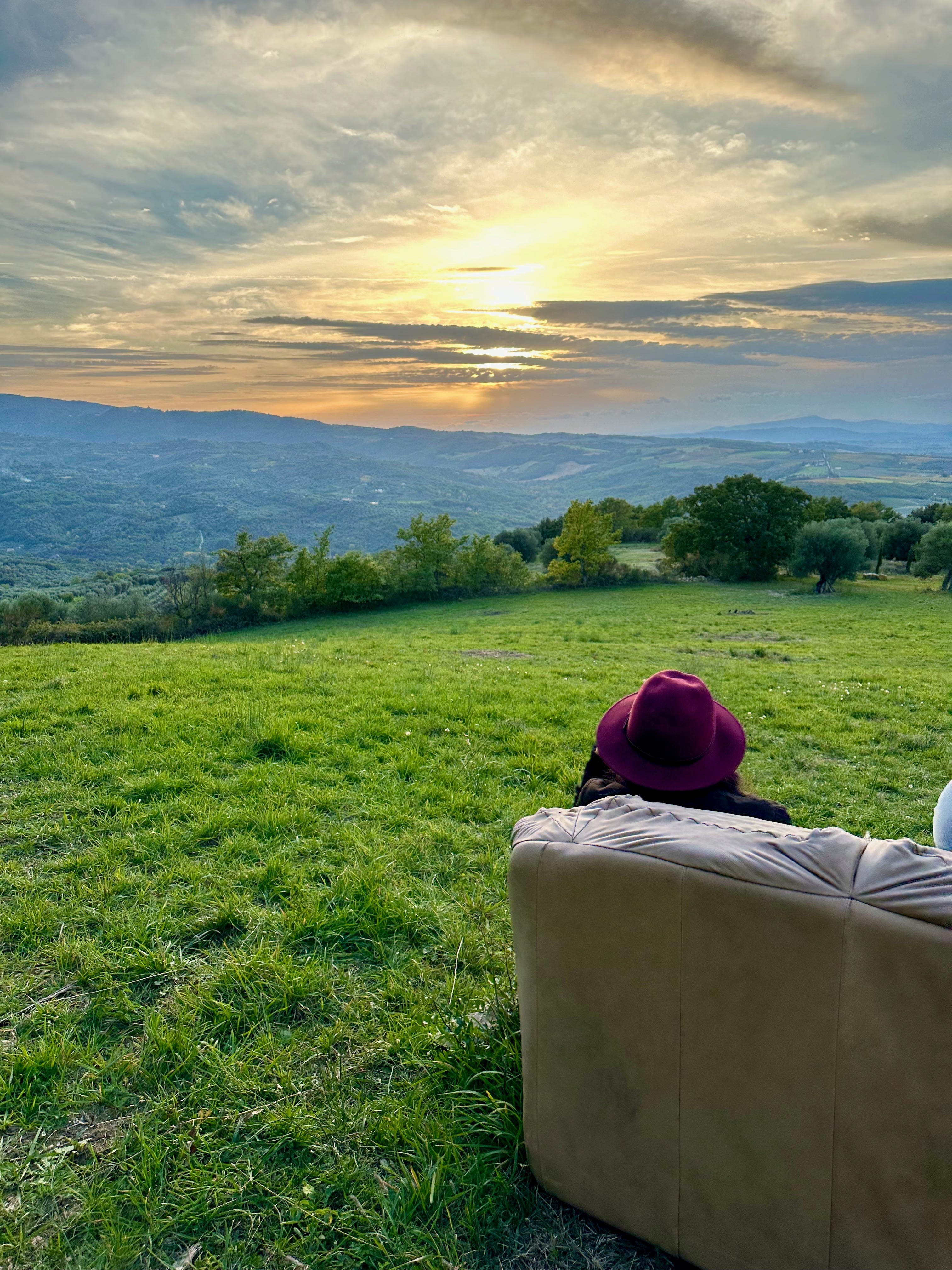
It’s really different for every book. The idea for Slow Burn came from a press trip to an olive oil grove and I was learning so much about how olive oil is made. And I was like, ‘This is a romance novel.’ And then the next summer we rented a house near there in a little quirky and lovely town near Tuscany.
My next book, The Apparent Trap, I wanted them to go somewhere in Scandinavia. They work at a morning show. My research for that was, I was a page, I worked in nightly news, I do theToday Show a lot, that’s a place that I have knowledge of. I wanted to send them somewhere to cover the winter Olympics, so I had to make up a fictitious winter place. Ten years ago I’d been to Northern Sweden; ‘I was like, this would be so fun.’ I went back to Sweden to do some [research]. I like to believe that my books take people on a vacation to a place.
The people–I would say every book ends up having a theme. With my first book, I really wanted to explore anxiety and how that affects relationships, as an anxious person. In my second book, I wanted to think about motherhood, fertility, and being working mothers, and how that affects women in their love lives. With Unlikely Story I was really interested in this idea of how there isn’t any one version of any one person. How do we present ourselves; what is real and not real? In Slow Burn I was very interested in exploring ambition, especially ambition for women. [My next book] The Apparent Trap is a lot about delayed grief and how loss affects us years later. You know the theory that the Sex in the City women are all different sides of one woman? All the characters are different pieces of me but none of them are me.
And then by the end I have sensitivity readers. For Unlikely Story, which has a therapist, I had two therapists the read book. For Slow Burn, I had Italian readers. I’ve always had readers of the places [I’ve written about].
Can you tell us about your new book?
The Apparent Trap is basically about a woman whose dad starts dating somebody way too young and so she and the girl’s dad team up to try to break them up, and they fall in love in the interim. I promise the ages work out in that. He’s not too old for her either! I call it my reverse parent trap book—they’re trying to break people up instead of trying to get them back together.
Who are some other romance authors you admire?
A lot of those people I mentioned before. Tia Williams and Kate Clayborn—I’m so in awe of their prose. I’ve been so lucky to have so many writers that I admired their work from afar become friends and be able to bounce things off of. I had dinner last night last night with Lauren Kung Jessen, whose books I loved, and we spent an entire evening talking about book marketing and how we’re feeling about it. It’s wild to have people whose work you were a fan of and then get to be their friend.
Do you have any recent favorite romance novels to recommend?
The best book that I read recently was The Best Worst Thing by Lauren Okie. That knocked me sideways because it’s so funny and so rip-your-heart-out, which I think is really, really hard to do.
What are your favorite romantic restaurants in New York City?
I love Leon’s. It’s Italian but with a hint of Egyptian. Everything is so good; they make the pasta. And it’s open all day so if someone’s like ‘Let’s get a coffee and a scone’, or for lunch, it’s always there.
Is there somewhere you like to go to treat yourself?
Pamina Dolci e Gelato. I think they make the best gelato in New York. They own an Italian shop next door, too. It’s an Italian guy, they make in house, it’s just one location, and it’s so good.
Do you have a go-to flavor or two?
They do fruit flavors from local stuff, so like in the summer they have Mara de Bois strawberries, apricots; in the fall they have a Concord grape flavor. There’s a flavor called tropical—it’s like mango-passionfruit—that they have all the time. And just their straight-up chocolate, they also have an olive oil one…
How can people find you and support your work?
The best way is Substack. My newsletter is Ali’s Happy Books—I usually recommend a cookbook and a novel that I’m enjoying, and then I usually put some happy news of the week, so like articles and things. It’s just my little place to spread joy.
This issue is the perfect amalgamation of all the things I've come to love about your newsletter: words, writing, books, and food!